
“`html
Exploring the Intricacies of 3D Printing Technology
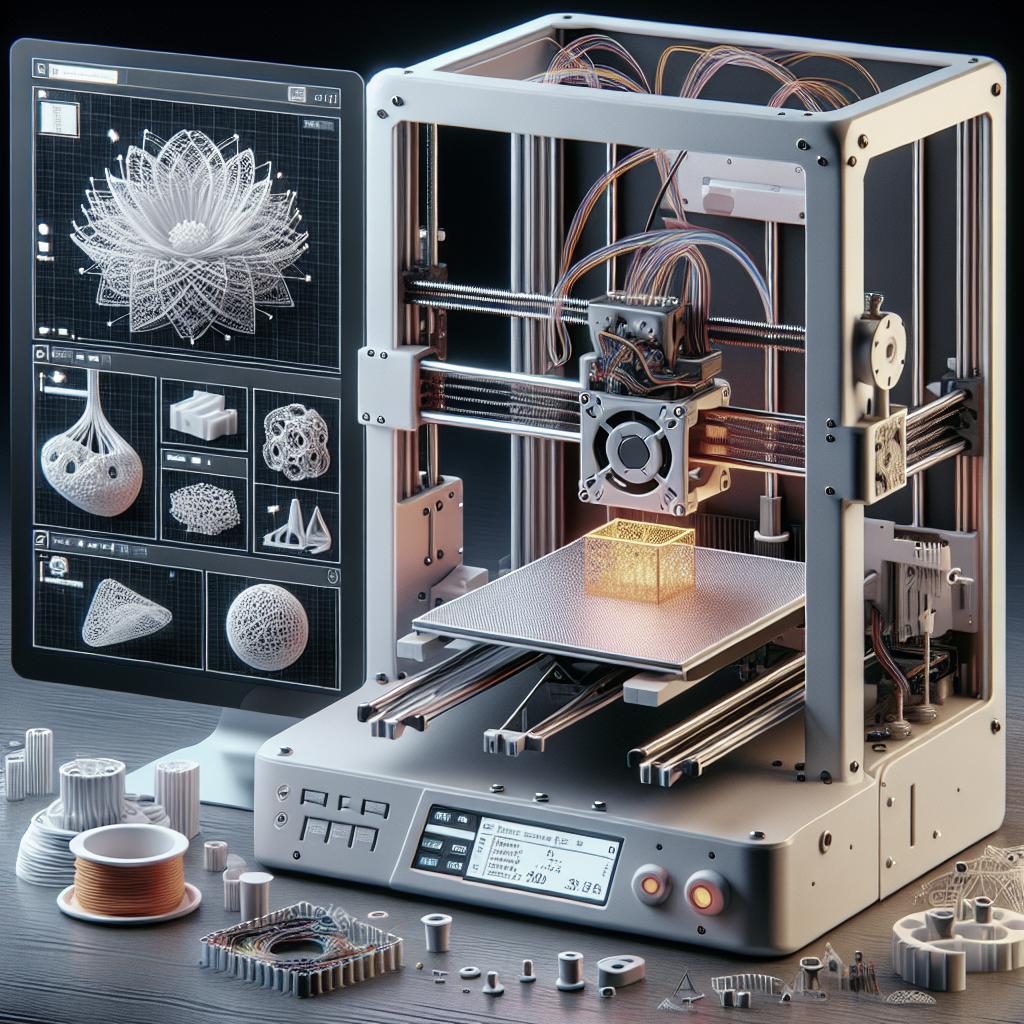
3D printing technology, or additive manufacturing, is revolutionizing industries by allowing the creation of complex structures with precision. From manufacturing and healthcare to food and education, this technology is reshaping how we approach problem-solving and innovation. Starting from digital blueprints using 3D software, the process moves to slicing, which prepares the information for the printer, ushering the digital into physical reality. Various printing methods are employed, each suitable for different materials and purposes, showcasing versatility in its applications. As we delve deeper into this technology, we’ll explore its existing applications, future potential, and current services, offering invaluable insights for businesses and individuals alike.
How Does 3D Printing Work?
3D Software
The first step in 3D printing begins long before any material is layered onto the platform. It starts with a digital design using 3D modeling software such as AutoCAD, Blender, or Tinkercad. These tools allow designers to create a detailed digital blueprint of the object they wish to print. The precision of these digital models is paramount, as it dictates the quality and feasibility of the physical print.
Modern 3D software provides extensive libraries of pre-built models and the ability to simulate different materials and structures, offering designers a tangible sense of the final product. This step is crucial for prototyping new products, experimenting with shapes and materials, and making corrections before transitioning to the manufacturing process.
Slicing: From file to 3D Printer
Once a design is finalized, the digital model needs to be prepared for the 3D printer through a process called slicing. Slicing involves converting the model into cross-sectional layers, a task performed by slicing software such as Cura, Slic3r, or proprietary programs from printer manufacturers. This software translates the digital model into G-code, a language that guides the printer on how to construct each layer.
During slicing, settings like print speed, material heat, and layer thickness are configured to influence the print’s precision and quality. This process forms the bridge between the digital and physical worlds, ensuring that the printer faithfully represents the model through meticulous layering.
3D Printing Industry
The 3D printing industry is a dynamic and rapidly growing sector with its fingers in nearly every aspect of modern manufacturing. What began as a means for rapid prototyping has blossomed into a multi-billion dollar industry with applications in various fields. Companies are investing heavily in 3D printing technology to enhance production efficiency, reduce waste, and create custom solutions.
Numerous startups and established corporations alike recognize the potential of 3D printing to innovate and disrupt traditional manufacturing processes. Adopted widely across industries, 3D printing presents countless opportunities for customizing products, optimizing supply chains, and advancing technological growth.
Examples of 3D Printing
Rapid Prototyping & Rapid Manufacturing
Rapid prototyping is one of the earliest and most profound applications of 3D printing, allowing designers to create physical models of their concepts quickly. This application has transformed product development, enabling rapid iterations and real-world testing without the high costs and delays of traditional prototyping methods.
Similarly, rapid manufacturing leverages 3D printing for full-scale production of items, especially in flexible production settings where consumer demand might call for varying designs. This shift towards agile manufacturing aligns with the concurrent push towards customization and personalization in today’s market.
Automotive
In the automotive industry, 3D printing is being used to create lightweight and durable components, prototyping car parts, and even personalizing vehicle accessories. Companies like Ford and BMW are investing in 3D printing to streamline production processes, reduce prototype costs, and increase the speed of innovation.
By using materials like carbon fiber-reinforced polymers and metals, automotive engineers are able to produce structurally sound parts that achieve optimal weight reductions — a critical factor in enhancing vehicle performance and fuel efficiency.
Aviation
The aviation industry has been quick to capitalize on the benefits of 3D printing, where weight reduction and material efficiency are priorities. Aircraft manufacturers are using additive manufacturing processes to produce complex aero parts, such as engine components and interior cabin parts, with reduced assembly requirements and improved performance.
Incorporating 3D printing technology reduces manufacturing time and waste, allowing significant cost savings while maintaining or even improving upon the strict safety and reliability standards crucial in aviation.
Construction
3D printing is making waves in the construction industry with the development of 3D-printed houses and buildings. Using giant printers capable of extruding concrete and other building materials, entire structures can be constructed in a fraction of the time and at a lower cost compared to traditional methods.
The environmental benefits are also noteworthy, with reduced material waste and the ability to use recycled materials. This approach poses a potential solution to the global housing crisis, offering affordable and sustainable housing options.
Consumer Products
Consumers today can experience the benefits of 3D printing directly through custom products such as personalized phone cases, jewelry, and even fashion. Small businesses and artisans use 3D printing to explore product designs that cater to niche markets and quirky customer requests.
This democratization of manufacturing is empowering individuals and small companies to compete with larger firms by providing custom products at lower costs, ultimately reshaping consumer expectations for customization and speed of delivery.
Healthcare
3D printing has made significant advances in the healthcare industry, where it is being used to create patient-specific medical devices, implants, and even tissue engineering applications like scaffolds for regenerating organs and bones. This personalization improves the fit, comfort, and effectiveness of medical devices, from dentures and prosthetics to orthopedic implants.
The capability to quickly produce anatomical models based on patients’ medical scans provides healthcare professionals with valuable tools for education, surgical planning, and research, ultimately advancing patient care and outcomes.
Food
3D printing has also extended into the culinary world, where it is used to create intricate food designs and customize nutritional content. From chocolate and pasta to meat alternatives, food companies and chefs are experimenting with additive manufacturing to deliver personalized gastronomy experiences.
This application is not only about aesthetics but also about addressing particular dietary needs, providing tailored nutrition solutions, and exploring sustainable food production methods for the future.
Education
Education institutions are utilizing 3D printing to provide hands-on learning experiences across various disciplines, from engineering and science to art and design. Students are empowered to take concepts from the theoretical stage to practical application, fostering creativity, innovation, and problem-solving skills.
With the integration of 3D printers into STEM curricula, students can prototype and test designs easily, enabling a deeper understanding of engineering principles and promoting a culture of experimentation and iterative learning.
Types of 3D Printing Technologies and Processes
Vat Photopolymerisation
Vat Photopolymerisation is a 3D printing process that involves curing liquid photopolymer resins using light. Techniques such as Stereolithography (SLA) and Digital Light Processing (DLP) are popular iterations of this method. Layers are selectively solidified to form intricate parts with a smooth surface finish, often suitable for detailed prototyping and model making.
Material Jetting
In Material Jetting, tiny droplets of build material are selectively deposited and cured layer by layer. This technology allows for the production of multi-material and multi-color parts, making it ideal for prototypes that require high detail and color accuracy. As a result, this method is popular in creating aesthetic models and presentation-ready displays.
Binder Jetting
Binder Jetting involves spreading a powder material across a build platform, followed by the selective deposition of a binding agent to glue the powder particles together. This process is repeated layer by layer until the part is complete. Binder Jetting is known for its ability to produce metal parts, aerospace components, and colorful, full-textured 3D models directly.
Material Extrusion
Material Extrusion, commonly embodied by Fused Deposition Modeling (FDM), involves the extrusion of thermoplastic filament or material through a heated nozzle that hardens upon deposition to form each layer. It is one of the most common and affordable methods in desktop 3D printing, suitable for producing durable prototypes, basic functional parts, and educational projects.
Powder Bed Fusion
Powder Bed Fusion encompasses several techniques such as Selective Laser Sintering (SLS) and Direct Metal Laser Sintering (DMLS). In this process, a high-power laser fuses particles of powder together, forming a solid structure. Powder Bed Fusion is widely used in the production of both plastic and metal parts, with applications spanning aerospace, automotive, and healthcare industries due to its precision and material compatibility.
Directed Energy Deposition
Directed Energy Deposition is a more advanced 3D printing process that uses focused energy in the form of electron beams, lasers, or arcs to melt materials as they are deposited, typically in powdered or wire form. This technology is employed especially for large-scale repairs and coating applications, finding particular use in the aerospace and defense industries for its ability to handle high-stress material applications.
Materials
The variety of materials used in 3D printing is vast and continually expanding, with options ranging from thermoplastics and resins to metals, ceramics, and biomaterials. Each material has specific properties that make it suitable for different applications, such as strength, flexibility, heat resistance, and biocompatibility.
As 3D printing technology advances, researchers and companies continually develop new materials that enhance the mechanical properties, reduce costs, and expand the potential applications, bringing innovation across every field from industrial manufacturing to healthcare solutions.
Services
3D printing services are increasingly available to help individuals and businesses realize their design visions without having to invest in costly equipment. These services range from 3D model design and scanning to producing prototypes, finished parts, and even full-scale manufacturing runs.
With accessible platforms that allow users to submit designs for production, many service providers also offer additional support, including material selection, finishing options, and quality assurance, making 3D printing more attainable and versatile for a wide array of users.
| Section | Content Summary |
|---|---|
| How Does 3D Printing Work? | Overview of 3D software and the slicing process, preparing digital models for printing. |
| 3D Printing Industry | Exploration of the industry’s expansion and integration into various sectors. |
| Examples of 3D Printing | Applications across industries like automotive, healthcare, and construction. |
| Types of 3D Printing Technologies and Processes | Description of various 3D printing technologies like Vat Photopolymerisation and Material Extrusion. |
| Materials | Overview of diverse 3D printing materials and their applications. |
| Services | Insight into 3D printing services available for different needs and scales. |
“`